Project Type: Academic Studio | Bahir Dar, Ethiopia | 2015
Urban Health Through Design
Location: Bahir Dar City, Ethiopia
Context & Vision
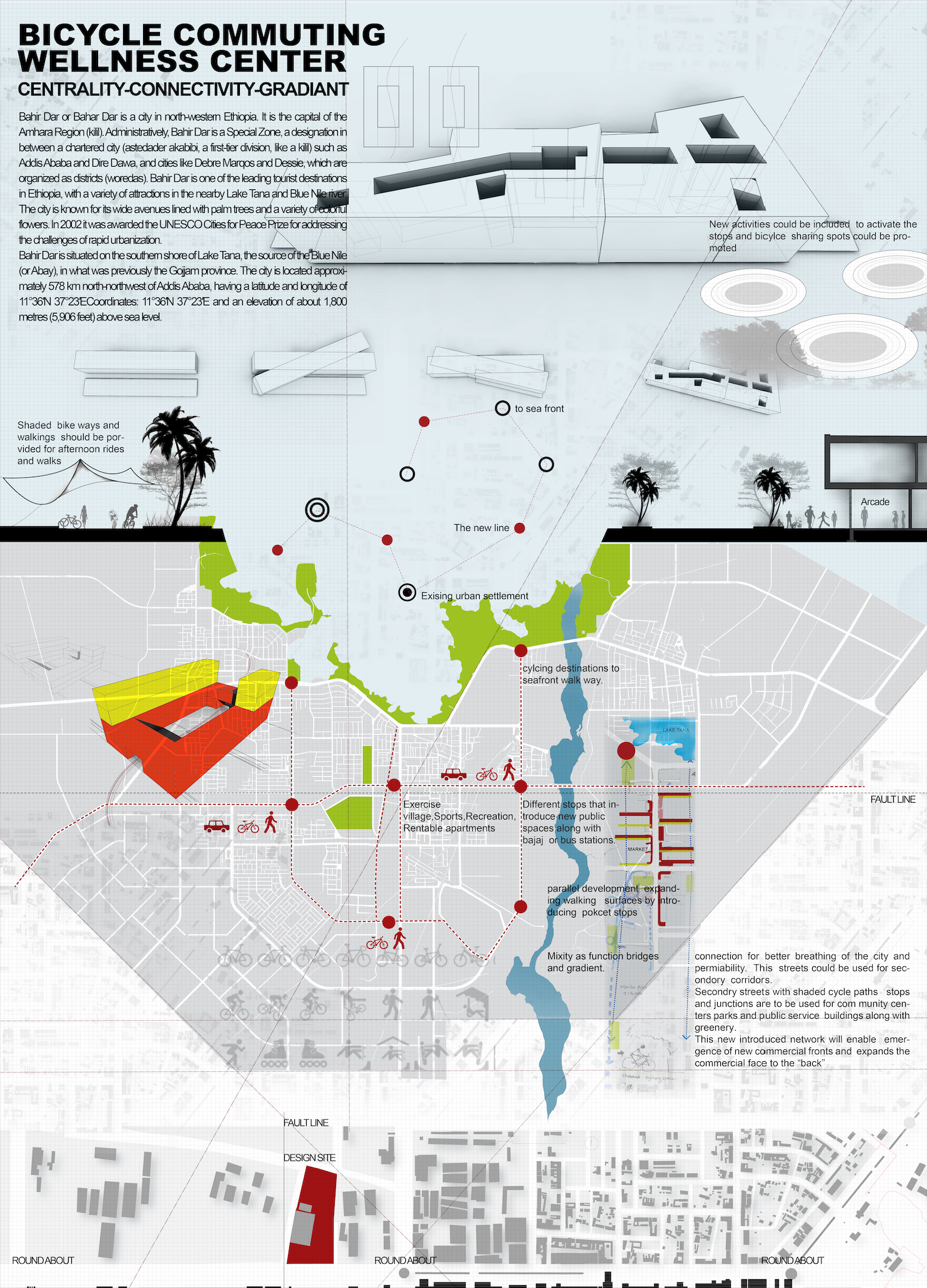
Bahir Dar, one of Ethiopia’s rapidly urbanizing cities and a UNESCO Cities for Peace laureate, faces the classic paradox of growth: congestion, fragmentation, and declining pedestrian quality. This student studio project sought to flip that narrative by linking mobility, health, and spatial logic into one integrated proposal: a Bicycle Commuting Wellness Center.
The design wasn’t just about bikes. It was a statement on city form, access equity, and street culture using mobility as a tool for collective wellness and green connection.
Design Strategy
Theme: Centrality · Connectivity · Gradient
- Mobility Network Overlay: A new network of shaded cycle paths and pedestrian boulevards layered onto the city’s back streets, linking neighborhoods to the lakefront and key landmarks.
- Cycling + Program: Strategic “pocket stops” along the network combined cycling infrastructure with rentable apartments, gyms, arcades, and shaded resting plazas.
- Edge Activation: The waterfront, typically treated as a boundary, was reimagined as a front-facing wellness zone and recreational loop.
- Gradient Spaces: The design responded to the site’s topography by assigning functions to natural levels, elevating architecture while embedding walkable community spaces on the ground.
Reflections
This was a pivotal early project. It taught me that mobility isn’t about roads, it’s about how people live, stop, and recover. Good urban design must address not only how people move, but also how they pause, gather, and heal.
We weren’t just proposing a building. We were prototyping a breathing corridor, one that reconnected the city to its human pace.
Brook Abebe
Urbanist. Strategist. Educator.
Work completed during undergraduate study, 2015.
For inquiries or collaboration: [contact]
In cooperation with Yohannes Afework

