Academic | Wits University, 2015
Location: Johannesburg Mining Belt, South Africa
Context & Problem
The Johannesburg mining belt is a scar across the city’s landscape—a massive swath of degraded land, tailings, and toxic dust that sits between formal and informal urban settlements. These post-mining zones are often seen as unusable, polluted, and politically paralyzed. But what if we reframed them not as wastelands, but as latent ecological and social infrastructures?
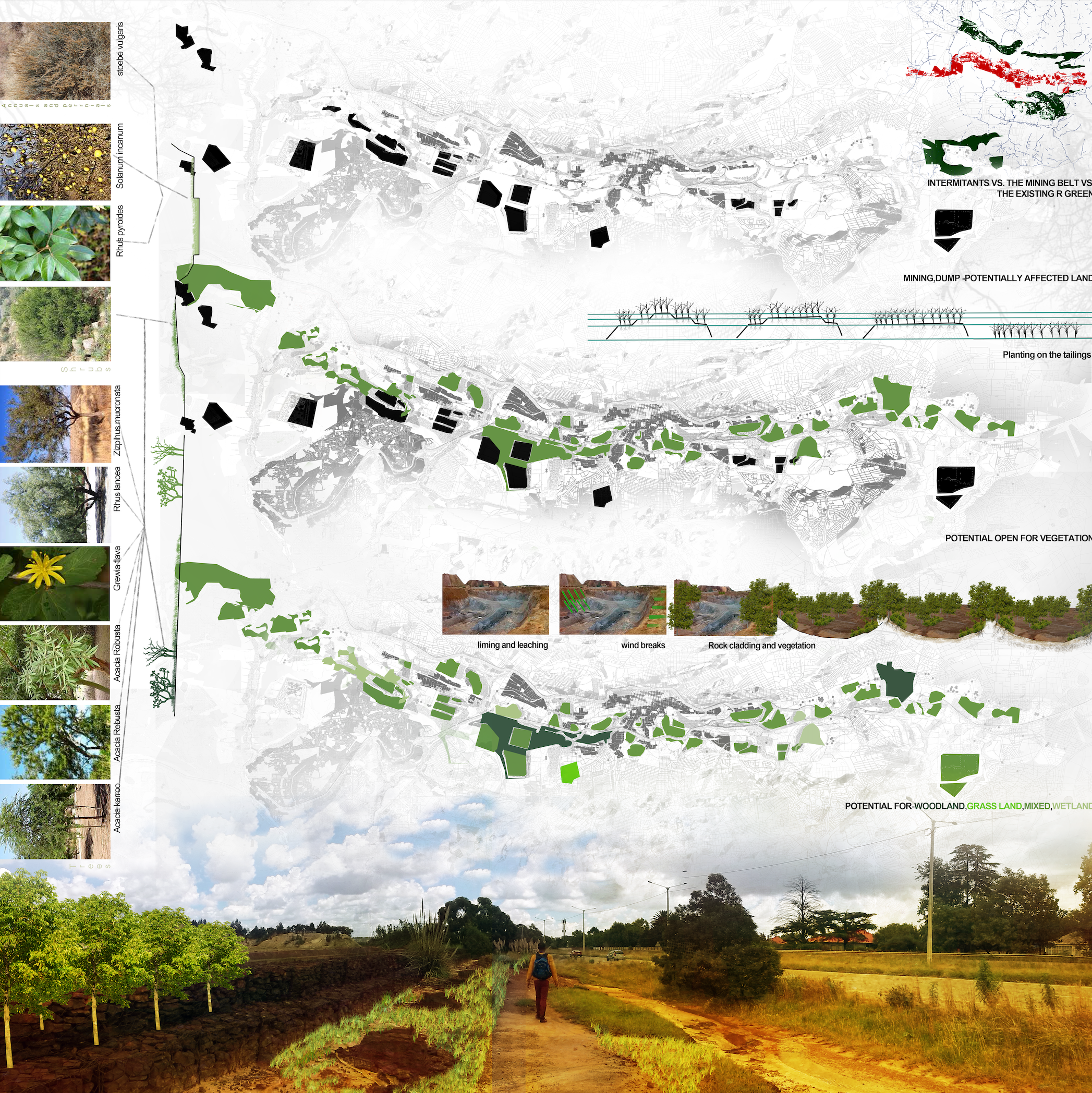
In this academic studio at Wits University, the design brief was to propose ecological rehabilitation strategies for these derelict zones while addressing the environmental, social, and spatial impacts of historical gold mining operations.
Design Strategy
The concept was based on vegetative repair, ecological zoning, and community interfacing:
- Ecological Stratification: Different plant species were proposed for different soil and pollution conditions. Native trees, grasses, and shrubs were mapped for each zone, emphasizing phytoremediation and dust control.
- Edge Activation: Interfaces between mining dumps and residential zones were transformed into transition parks, using plantings and paths to buffer and reconnect.
- Linear Greenways: A system of corridors was proposed along ridges and dump edges, framing trails, bioswales, and community agriculture zones.
- Phased Implementation: The project proposed a tactical and staged approach, starting with low-cost windbreaks and soil remediation, then moving toward public infrastructure and woodland restoration.
Reflection
This project was one of my earliest attempts to merge design with healing, treating land not just as an object of use, but as a memory field. Working in Johannesburg, a city built on extraction, forced us to think beyond beautification into restoration as justice.
It taught me that urbanism doesn’t begin with buildings. It begins with land.
Brook Abebe
Urbanist. Strategist. Educator.
For inquiries or collaboration: [contact]
Work created as part of academic study at Wits University (2015).

